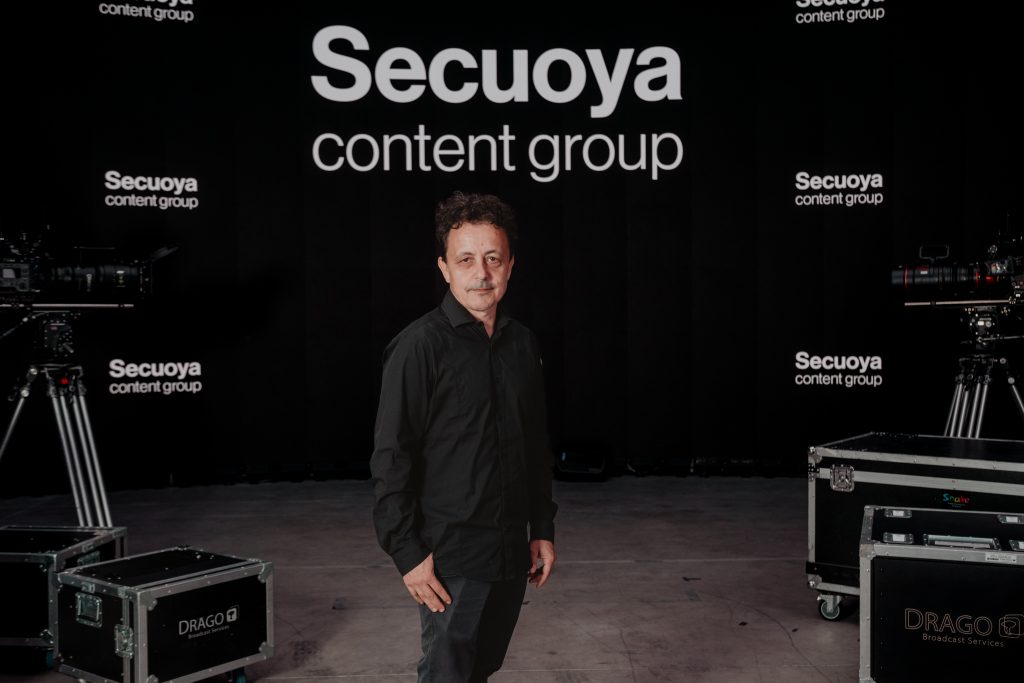

Pablo Jimeno, general director of the group, spoke at the opening panel Madrid as an international reference, where he emphasized the role of the content industry in the global projection of the region.
Secuoya Content Group played a leading role in the opening session of the Madrid Investment Forum 2025, held on September 22 at the Club Financiero Génova. Representing the group, its general director, Pablo Jimeno, took part in the roundtable Madrid as an international reference, together with leaders of companies such as Tendam, Oracle, ASPRIMA, and Lilly.
With this participation, the audiovisual group placed on the table the relevance of its sector in the international projection of the Community of Madrid and the key role of the content industry as an engine of innovation, employment, and competitiveness.
Three Key Issues in the Debate
In the first part of the dialogue, focused on Madrid’s leadership in attracting foreign investment, it was highlighted that the region concentrates more than 70% of the foreign capital arriving in Spain. Pablo Jimeno stressed that this positioning also responds, in the case of the audiovisual sector, to the combination of a predictable and competitive regulatory framework, the existence of a consolidated previous industry — originally driven by free-to-air television and strengthened by the emergence of OTT platforms — and the positive international image of a city that “is in fashion” and attracts talent, investment, and international productions.
When addressing the future of Madrid as an economic engine, Jimeno advocated for the opportunity to consolidate the region as a benchmark audiovisual hub in Europe and Latin America. He recalled that the sector already represents 2.6% of Madrid’s GDP, contributing more than €7.2 billion and over 100,700 jobs. In addition, he highlighted the multiplier effect of the industry: “each euro generated in the audiovisual sector translates into €2.1 additional in the Madrid economy.”
In his speech, Jimeno also pointed to three major opportunities that can strengthen Madrid’s role as an audiovisual hub. The first is related to the international context: after the tightening of regulatory frameworks in countries such as the United States, the Spanish capital presents itself as a reliable alternative, with competitive costs and a more predictable environment for large productions.

The second opportunity comes from Europe. The modification of the Television Without Frontiers Law, which leaves the United Kingdom out of the “European production” quotas, opens the door for Madrid to attract projects that until now were concentrated in London, and even to become the headquarters of major international groups.
Finally, the executive highlighted the transversal impact of the audiovisual sector on industries such as tourism. The so-called screen tourism moves around 100 million travelers each year worldwide, and Madrid is already taking advantage of this trend: more than 30 municipalities in the region are part of routes that allow visitors to tour series and film locations, consolidating the city as a cultural and tourist reference of global reach.
The meeting ended with a summary exercise in a single sentence. In Jimeno’s case, his conclusion was clear: “Madrid is destined to be the Hollywood of Europe.”
The Strategic Value of the Audiovisual Industry
The participation of Secuoya Content Group in this forum highlights the growing weight of the audiovisual industry in the Madrid economy. The group, a benchmark in content production and audiovisual infrastructure management, has been both a witness and a key player in the region’s momentum, attracting international projects and promoting the creation of qualified employment.